
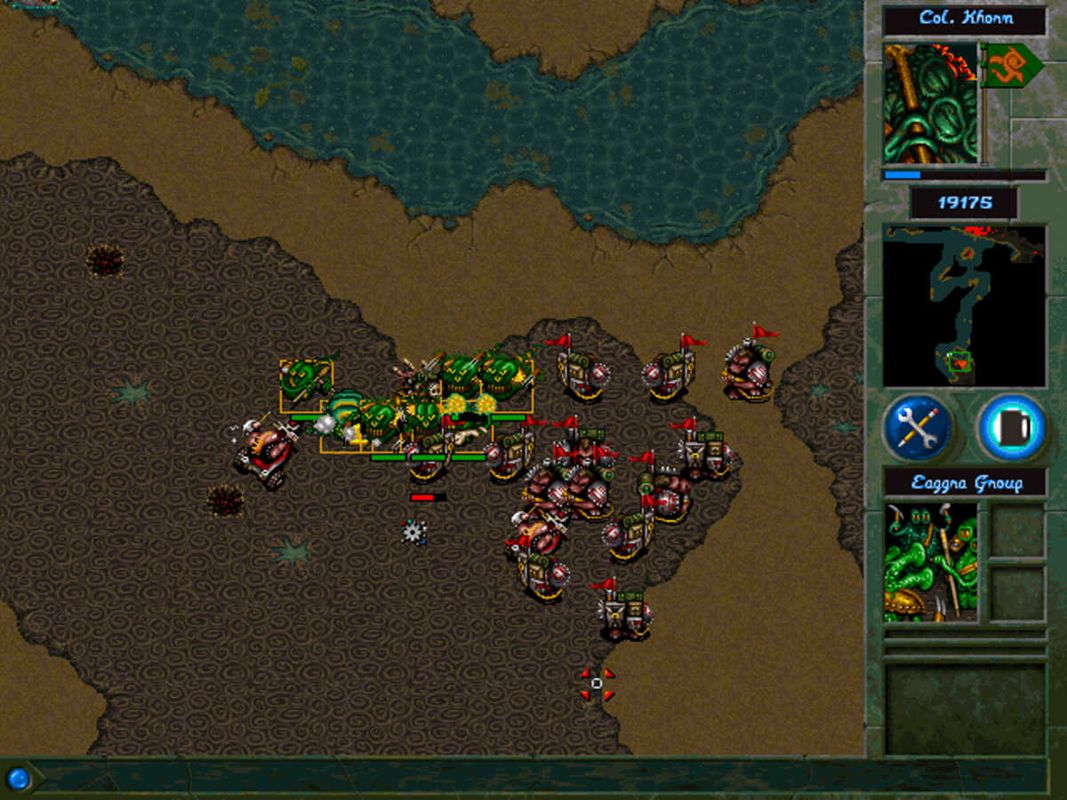

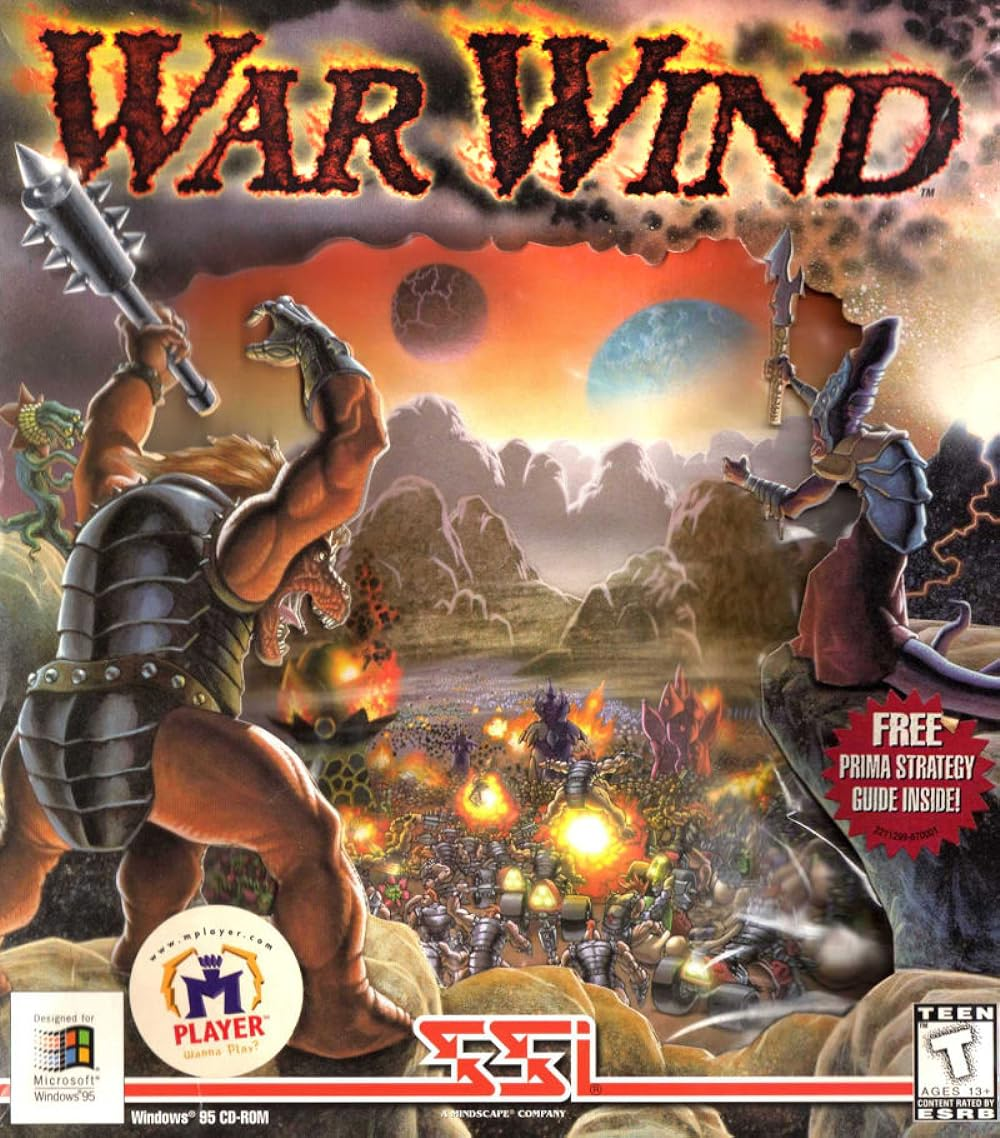
War Wind is a somewhat lesser-known RTS game which released in 1996. Developed by DreamForge Entertainment and pubished by SSI, this game played a huge role in my formative years, and I was delighted when it was brought back onto GOG in 2016 and Steam in 2021 (I believe it is permanently free on both platforms).
War Wind stands apart from most of the core RTS franchises in several critical ways. Where something like Command & Conquer is an attempt to create a near-future experience specifically centered around the idea of armies clashing, and WarCraft is somewhat RPGlike with its low unit selection limit and focus on the stories of specific characters and their supporting armed entorage, War Wind’s storytelling and mechanical focus is something more akin to Homeworld in that it is more of an exploration of populations and their interactions with the world they live in. It’s a strategy game about small towns with leaders, serfs, and their protective soldier class surviving and fighting in a harsh world, and not as strictly only about armed combat in terms of story, lore and feel though mechanically it is still very much an RTS.
(To be clear, it doesn’t play anything at all like Homeworld, it’s just that both games lean strongly into people or cultures as a central focus of the storytelling and at least a supporting focus in their mechanical systems.)
War Wind has 4 factions: the snakelike Tha’Roon who bear a non-trivial resemblance to Skeksis from Jim Henson’s Dark Crystal, the mystical 3-eyed Shama’Li, the hardworking shrublike engineers of the Eaggra, and the warlike Obblinox, who bear some resemblance to large 3-legged pig/rhino/lizards.
The game populates maps with plentiful neutral animals which have a wonderfully varied array of interactions with the player’s units, structures, and resources. Two of the standout things that people generally remember about the game is that units can physically enter most buildings, and that the game has a novel and interesting stealth system with 5 different levels or types of stealth. But this is only scratching the surface.
Sadly, the game’s control scheme and mission design leave something to be desired for modern audiences, and it requires a truly resilient and patient player to explore the game’s systems.
In this article, I’m going to cover the game’s unique spin on creating a real time strategy formula, go over the art and story, and finish it off with the numerous quirks and flaws which might have led it to be passed over in favor of more tightly put together RTS like those made by Blizzard, Westwood, and Ensemble.
Right up front I need to state: while I have a tremendous respect for the design ideas that went into this game, and love it dearly, it is so incredibly awkward to play in the modern era that it’s very hard to recommend someone go and try it, even with the game being free. I’ll get into this in the meat of the article, but this piece is more to examine the mechancal systems, story, and gameplay ideas than it is a recommendation of the game itself. That being said, it’s free (or at least really inexpensive) and I am providing links to it on GOG and Steam if you want to give it a try.
War Wind on Steam: https://store.steampowered.com/app/1741140/War_Wind/
War Wind on GOG: https://www.gog.com/en/game/war_wind
Table of Contents
- Table of Contents
- An introduction to the world
- Visuals and user interface
- Meet the factions
- Core systems time, baby!
- Bestiary
- Flawed
- Conclusion
(Check out the other Historical RTS articles: Historical RTS: Universe at War Earth Assault and Historical RTS: Z)
An introduction to the world
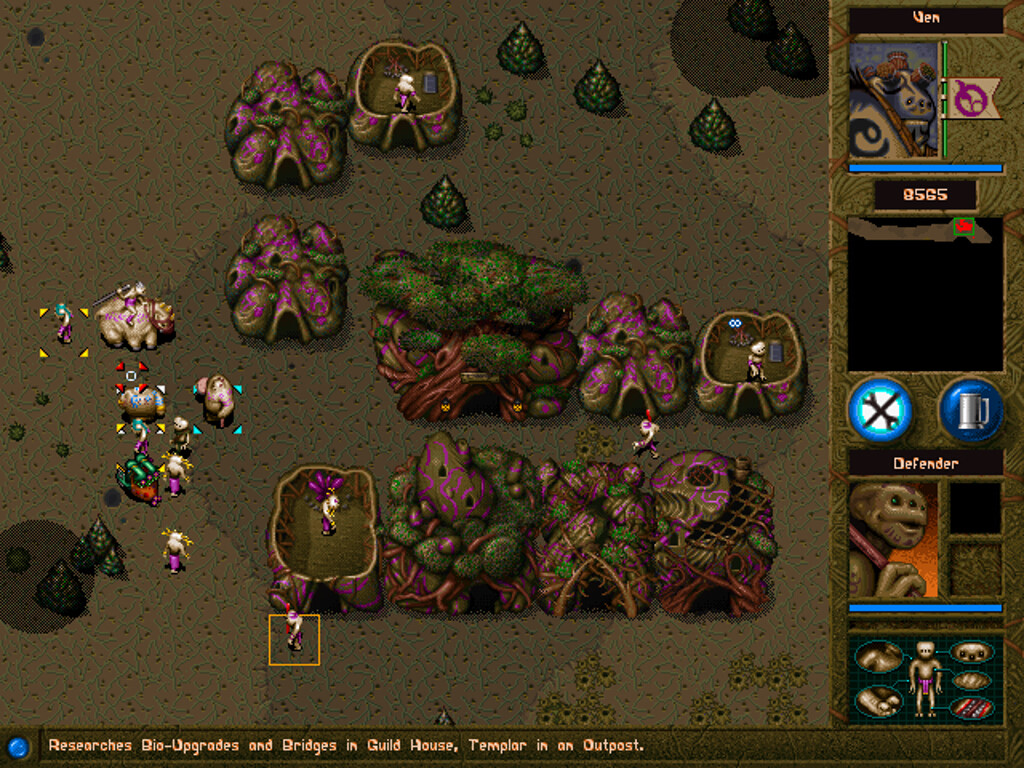
As I mentioned in the introduction, War Wind is somewhat unique in that it has absolutely no factions or characters that are human or look human. It is the story of an alien world called Yavaun, populated by 4 species. I mentioned them briefly above but since this is so critical to both story and gameplay, I’m doing to go into more detail below.
As of the opening of the story, Tha’Roon are the ruling species on Yavaun. For more than thousand years, they have enslaved the plantlike Eaggra with the assistance of their other slaves whom they use as a military force, the 3-legged Obblinox. The story of the game begins with an Eaggra uprising which forms a non-trivial portion of the narrative of each faction.
Each campaign features 7 missions with cutscenes after each. I’ll cover the missions more in the “Flawed” section below, but generally they’ve been described as very puzzle-like for RTS missions, often with unclear directions and “search for the 1 last thing you forgot to do/kill” gameplay. But we have some ground to cover before we get there. Let’s move on to art and design and circle back around to issues later.
Visuals and user interface
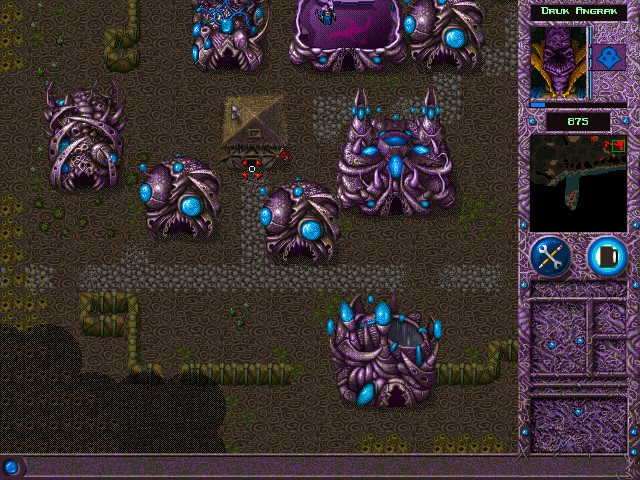
While at times striking, (at least as far as I’m concerned, though I might have some rose-colored glasses for this game) some of the artistic decisions in War Wind can be visually messy. Many elements of the game have busy and dense textures that can harm readability of information. For instance, you can see the Tha’Roon HUD above is very busy. Some of the terrain also is very visually dense with swirly patterns in the dirt overlaid by tree stumps, or foliage, and stealth indicators on units get crowded when there are several units clumped together.
The game’s main menu is pretty but is pretty unintuitive to look at:

Each of the shapes in the corner represents one faction’s campaign, the diamonds represent actions like loading saved games, credits, and things, and the combined glyph in the center is multiplayer. There’s a tooltip at the bottom center of the screen that updates when you mouse over an option but this main menu is, while possibly somewhat immersive into the mood of the game, neither particularly helpful nor particularly visually engaging.
One cool (to me at least) element of the game is what I’ll call the contextual menu. There’s an image of this below. Right clicking on a unit brings up a group of icons that represents what the unit can do. On a unit you’re hiring out of an Inn, it’s just a thumbs up to hire the unit or a thumbs down to dismiss it (useful if the Inn is full and you want to get other unit types to show up), and on a combat unit it’s usually as simple as move, attack, and stop.
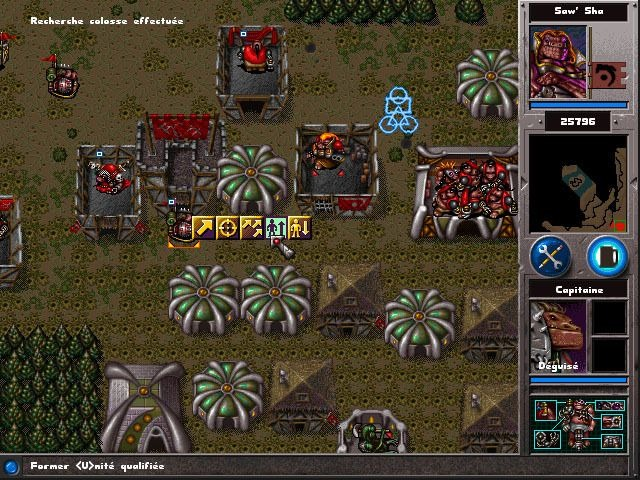
But for worker units or your leader character, the menus often get long quickly. And for anything that can build or for spellcasters, there are sub menus which pop up. It keeps your focus on the center of the screen, but can be cumbersome to interact with and can easily hide stuff under the menu. It’s all hotkeyed but it’s less convenient than something like StarCraft or WarCraft chose to do with command cards.
This game was, of course, created before we settled on modern control schemes, so it takes some learning.
Another frustating thing is that when you have a group of units selected, it just shows on your sidebar as a single “group” object, which is absolutely worthless for unit management. You can select a lot of units at once, but it’s not infinite. Without counting, I think it’s about 20 individual units? Oh also, for those used to Control Groups and Shift-move, look out! Creating a group in War Wind is done with Shift (e.g. Shift+1 to set group 1), units are ordered with left-clicks, and Alt brings up a waypoint move mode which is neat but arguably not very useful.
Meet the factions
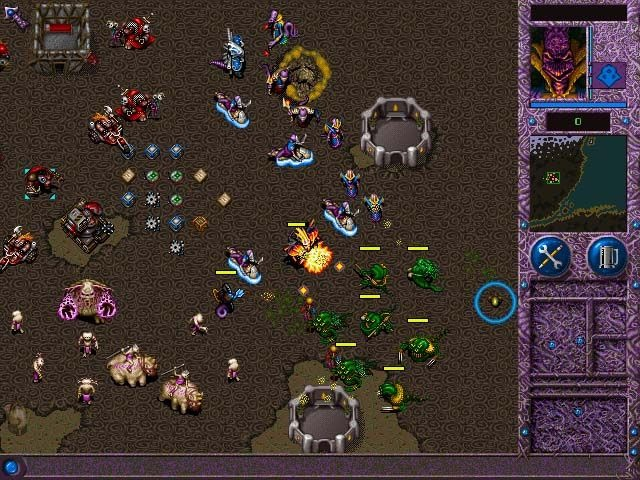
Visually, the Tha’Roon are gnarled purple creatures, with a vaguely humanoid torso, but with beaked faces, extremely tall craniums, and snakelike tails in place of legs. As I mentioned above and may yet mention again, they remind me somewhat of the Skeksis from the movie The Dark Crystal. They are aristocratic and cruel, and favor psychic spellcasting, hover technology, flamethrowers, and similar sadistic weaponry. Technologically they are the most advanced species with powerful units and weapons, but they’re terrible builders with expensive upgrades, and often have smaller numbers of units than their opponents. Pound for pound though they tend to be the best in combat, though their mounted troops are the worst and most subject to disruption.
Physically strongest are the matriarchal Obblinox. Somewhat analogous to orcs in other media, these 3-legged bruisers are durable and combat-focused with a strong sense of honor. Actually somewhat narratively complex, the Obblinox start out on good terms with their masters the Tha’Roon, but actions they’re asked to perform, such as the genocide of noncombatants, leads some to split away and join the Eaggra cause. Also, while they mostly read as bulky warriors, they have their own mystical traditions and strong mechanical skills that lead them to augment themselves with mechanical limbs. Personally I don’t enjoy their visuals or playstyle as much as the other factions, but I can respect what DreamForge were going with here.

The Eaggra are the most visually distinct faction in War Wind and one of my favorite visual designs in all of RTS. Plant people like living shrubs and bushes, Eaggra have eye stalks with varying numbers of eyes (most have 2, 3, or 4 eyes if memory serves), foliage, and vinelike arms. They are the best builders and most numerous faction, and fairly are adept at ranged combat with their scouts. And their architecture is gorgeous. Not ostentatious overdesign like the Tha’Roon nor plant-based like the Shama’Li, the Eaggra build simple greenhouse styled structures with gentle curves, understated gold accents, and green windows. They also like augmenting themselves with cybernetics, and it’s implied they learned this from the Obblinox.
And last but not least are the Shama’Li. A mystical people with an intense connection to nature, the Shama’Li live in treelike growth ciflonstructions. They have the best melee and magic of the 4 factions and have the most and best stealth of the 4, though they have low durability on average. The Shama’Li are seeking the god of Yavaun, an entity known as NagaRom, who they believe can bring peace to their world. They also seek to ally the Obblinox and Eaggra with them against the Tha’Roon.
Core systems time, baby!
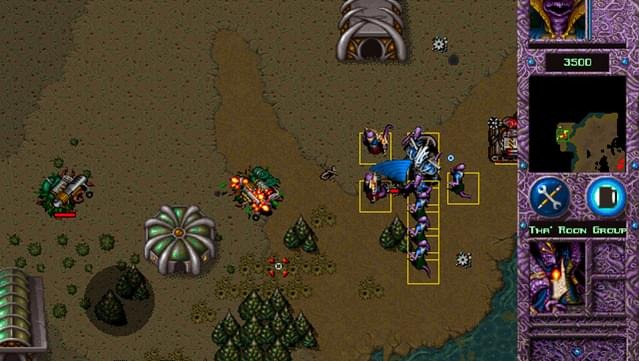
To me, this is the true meat of the game, and plays a huge role in why it’s stuck with me since childhood. In spite of the game’s quirks and myriad rough edges, War Wind is chock full of awesome ideas that still excite my imagination to this day.
I don’t have much to say on War Wind’s Line of Sight system, but I do want to give it a quick callout. Unlike in games such as Age of Empires 2 or WarCraft 2 or 3, trees are freely traversable by units. However, trees block line of sight for units outside of them: this means that ambushes from within a forest is entirely possible. This also means that when traversing the map, it’s generally best to walk in the forest when you can – since you can easily see out of trees and have full line of sight within forested areas, but you can’t see into trees unless you already have 1 or more units standing in a forested area.
One small frustration is that there is a minimum size for fog of war elements, meaning that on the edge of the fog of war there’s kind of a weird space where you’re not sure if you’d be able to see a unit or not. Thankfully, units are revealed in fog of war briefly when they attack, which does mitigate the frustration of wondering if you might be able to see something on the weird edges of visible area.
Buildings and construction

Buildings are one of the things most people remember most about War Wind: most buildings in the game can have 1-4 units actually walk “inside” of the structure through its door, revealing the interior of the structure to the player and protecting the units inside. Since units can’t pass through each other, it is possible to block off building interiors.
For all that it’s memorable, I don’t know what else there is to say about the system, It’s occasionally useful for ambushing enemies or hiding a damaged unit but ultimately feels kind of gimmicky in practice. Units do have to occupy at least the doorway of a structure in order to activate its function: research, upgrades, or training into a combat unit must be done inside, and units will wait outside until they can make their way in to do whatever thing it was they were told to do.
Construction itself is interesting: buildings are built from the inside, so once workers establish the foundation, they’re protected while they finish the building. But also, “completion” of a construction project is different in War Wind to almost any other RTS. A building is considered “complete” only about 50% of the way through its building process. All buildings start as a pile of rubble and then convert into a heavily damaged structure after its initial construction timer. The rest of the construction process is just repairing the damaged facility, which is fully usable after that point. This allows you to bring up bases fairly quickly, but will result in a very ramshackle outpost unless you let buildings complete or come back to repair them later.

Inns are the other primary use of the “building interior” system in War Wind. Once constructed (as above, once the foundation exists), units will appear in the inn. Inns have various settings they can be toggled between, but mostly fill up with worker units. Mounted cavalry riders also appear within Inns, which is most factions’ only way of getting them. Rarely, if their pre-condition is met, heroes will appear for hire, which is the most exciting use for inns.
Stealth
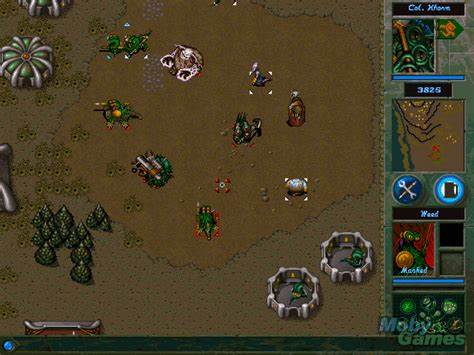
One thing most people remember about War Wind is its stealth system. The game has 5 levels of stealth: Normal, which I think is self-explanatory.
Masked units do not appear on their enemy’s minimap. Masked units have red triangles around their base. Disguised units look like enemy workers until they attack; they are shown with yellow triangles around their base. Hidden units: do not appear on the minimap and are translucent. They have bonus evasion (are harder to hit/higher enemy miss chance), and get teal triangles around their base. And, the last level of stealth is Invisible: Not visible to the enemy unless attacking. Distinguished by white triangles.
Each unit type has a base stealth level, and the Stealth upgrade allows the unit to be moved to the next Stealth level up – this can only be done once, so you can’t have an army of Invisile workers running around. Units with the vision upgrade act as detectors, which can pierce through all levels of stealth. This could have been made more interesting with various classes of detection to strip off various levels of stealth, but remains one of the more ambitious and novel stealth systems in the genre and could form the basis of a very interesting and robust system in a modern game.
Influence

Influence is a secondary resource in War Wind. Influence increases slowly over time, but can also be increased when you hire a new unit, or kill an enemy unit or building. the Leader of your faction can also purchase Influence via an ability. Influence is primarily spent on Research (covered below).
Hall of Heroes
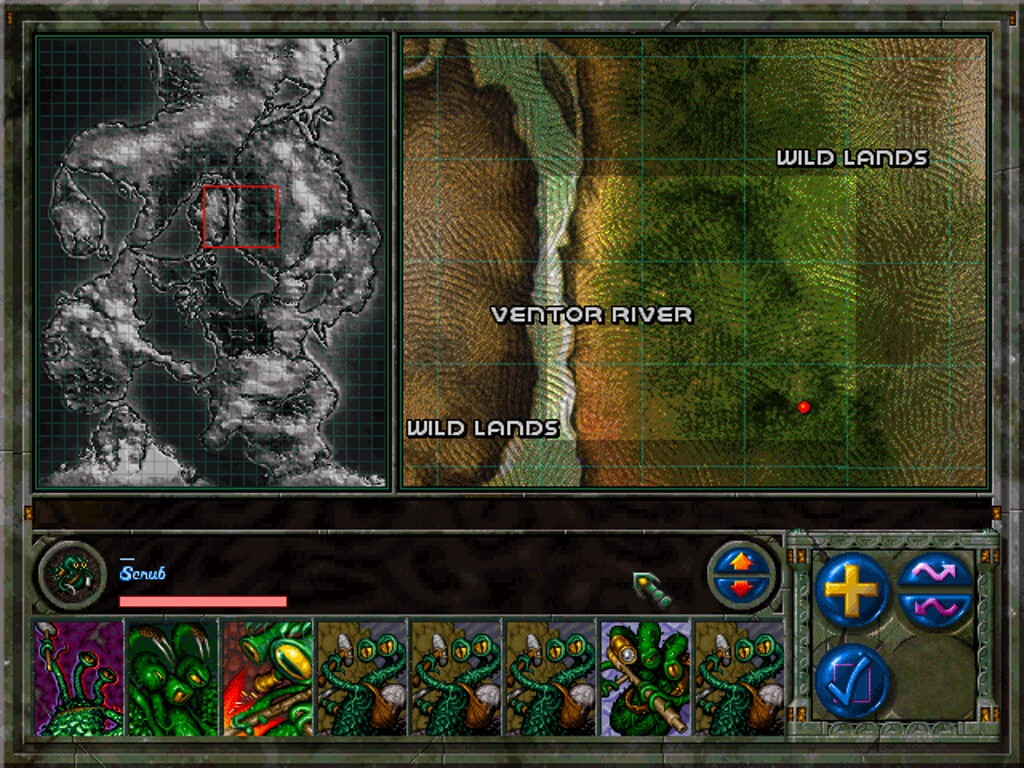
The Hall of Heroes is an interface you are taken to between missions in the campaign. In it, you are able to save some of the units you used in the previous mission, and take some of those units with you into the next mission. Units in the Hall of Heroes don’t have to be ‘hero’ units: any unit which survived the mission is eligibile, though you’re limited in the number of units you can bring forward from your last mission, and limited in the number of units you can pull from the Hall of Heroes to bring into the next mission.
This is kind of a light progression system, which encourages you to stack high impact units like heroes or spellcasters, but with how random combat outcomes can feel in the game, it never really makes it feel like you’re stacking the deck for yourself in future missions. And, with how limited the amount of units you can pull with you into the next level, it never really feels like you’ve shot yourself in the foot like it can in Homeworld if you’ve had a particularly bad time of it in a level. To me it falls into the sweet spot for loadout systems, where it’s enough to be noticed but not so much that you can cripple yourself with bad play. It’s not a bad take on the concept in my eyes.
Heroes
Heroes can show up in an inn if you’ve done a certain number of kills, trained a cartain number of units, lost a certain number of units, a whole host of things.It’s not well defined in the game, though I think it might be in the manual.
Heroes are more like a slightly more powerful version of an existing unit – they’re more like a C&C Commando than WarCraft 3 or Spellforce 3’s RPG style army centerpiece. Heroes often die pretty quick if you lose track of them but can be very valuable if babied. Also in the campaign, if you can preserve them they can follow you from mission to mission, living in the Hall of Heroes until called upon to be used in a mission.
Vehicles
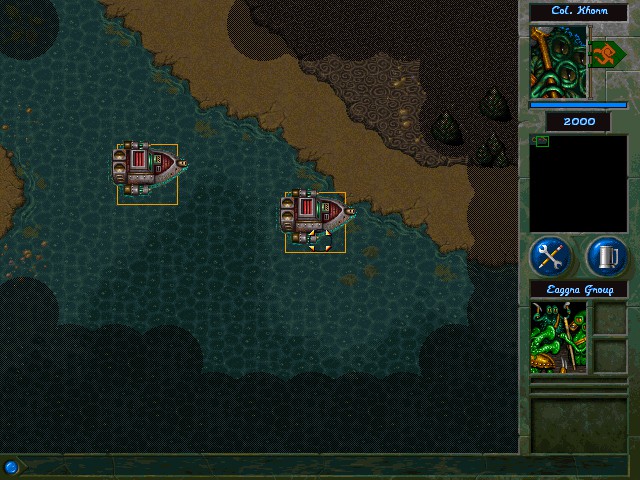
Most battle trucks in the field were designed by Obblinox engineers, and theys the units yer gonna be fightin’ against. The trucks may look different than the trucks yer gonna be drivin’, but believe me, inside they’re all the same. The enemy ripped off our transport design, but what matters most and what you grunts gotta remember is what these vehicles can do. As you can plainly see, each truck is outfitted with a ram which can do substantial damage in hand to hand situations. My advice? You want to live-stay outta their way, ya primitive screwheads!
Among the other things you can build or find on the map are vehicles. There are actually a ton of things that can be built from walls, to laser fences, roads, traps, alert beacons, and a decent number of things which can help with immersion and maybe can be useful on occasion (units move faster on roads for instance) but mostly I tend to ignore them when playing.
Vehicles though, are often useful. The 3 main vehicles are a Battle Truck, which can carry up to 4 units and has a pretty good melee attack, the Attack Cruiser, a ranged hover unit, and the War Barge, an aquatic transport which also has a ranged attack. There is also a Ferry, but all it does is move between 2 fixed points and drop off units at either end.
All vehicles carry 4 units and are neutral unless a player has at least 1 unit stored within the vehicle. They’re fast but often somewhat cumbersome to work with due to the low count for stored units
Units, upgrades, and more
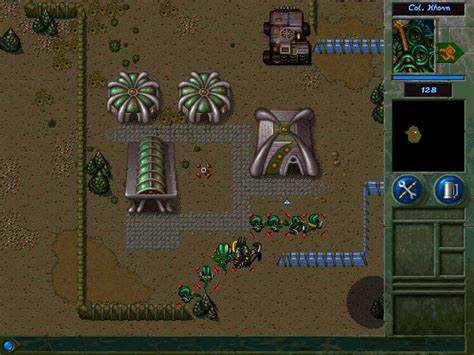
As popularized in the later Battle Realms, all combat units are upgraded or trained from worker units. This helps reinforce the feeling of your army being a population rather than just a war machine. It also simplifies unit aquisition via Inns, since all you really need are workers which serve as building blocks for the rest of your army.
Your basic harvester/builders also perform research, unlocking upgrades and additional construction options and Train at various buildings in order to turn into combat units (which can themselves become workers again, in case you need to do this; a nice touch!)
While this was greatly expanded on in the sequel, War Wind 2: Human Onslaught, Advanced units are a system in War Wind which adds a fun little wrinkle to the gameplay. Upon meeting their unlock criteria, such as training a certain number of the basic version of the unit and performing the appropriate Research, both combat units, spellcasters, and workers can be upgraded into superior Advanced units. This is critical for casters, who gain access to better spells, and workers, who gain access to a much larger set of building options, but having a couple of advanced combat units can also be valuable.
As with many things, the criteria for getting Advanced units can be a bit hard to decipher, but it generally involves having 3 or 4 of the base unit and having the base unit perform Research at the facility that trains that unit type.
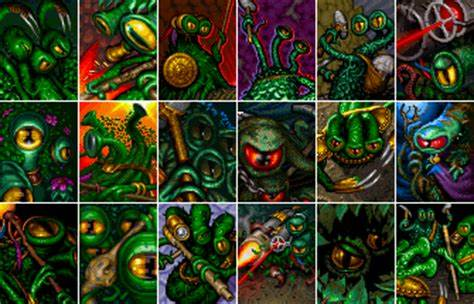
Units perform Research in War Colleges, Arcaneries, Technical Facilities etc to unlock upgrades, spells, advanced versions of units, and accessory construction projects like mines and vehicles. Any unit which received its training in a particular type of building can perform Research in that type of building: for example, a Tha’Roon Executioner can research the advanced Destroyer version of that unit in the Academy.
The results of Research are random (unless a unit can only research a single thing). A unit does not Research for a particular spell or ability, but performs “Research” in general. The results of the Research are then unlocked and announced to the player. Research costs both resources and Influence, making it pretty non-trivial to do given the relative scarcity of Influence in general. Research being random is… interesting, but not one of my favorite design patterns the game explored.
Bestiary
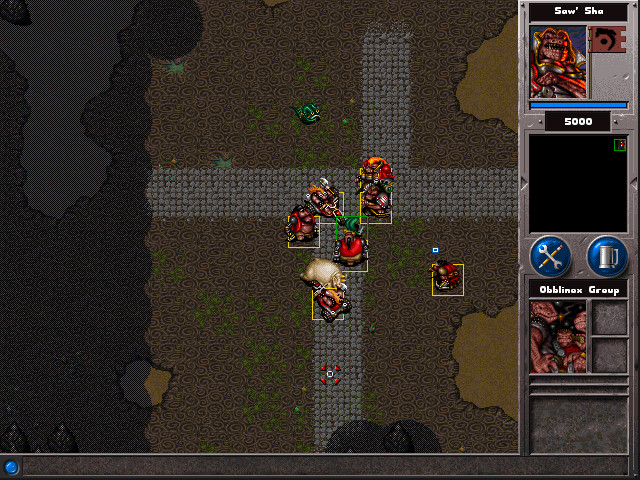
One of my favorite things about War Wind is its bestiary. The world is populated with a ton of annoying critters out to ruin your day. From the Ionic Brakus, which will wander near your mechanical units, shutting them down, to the Slinck Weed which disguises itself as a tree until you’re nearby, then attempts to kill whatever it can, to Dinge Vermin, which periodically run up to your Great Hall to steal your resources and can be quite pesky in packs when you attack them.
You also see some interesting synergies with neutral creatures, such as Fledgling Boncas, which will eat (attack) your buildings, but if attacked themselves will call heir nearby parent Boncas, which are normally docile but are durable and damaging and quite bothersome to put down.
Aside from forcing you to be on your toes to play the game, which has some good in it but some bad as well since they can be quite annoying at times, these neutral animals do help bring you into the world of Yavaun and help make it feel more alive (if annoying and occasionally terrifying). The fauna of Yavaun, as frustrating as it can be to deal with at times, remains one of my key memories of the game and something I would love to see more RTS attempt to do in order to build worlds which feel more immersive and alive to player, especially in single player focused games.
Flawed
In spite of all of the praise I have given the game above, War Wind is a deeply flawed experience that is very hard to recommend to the modern gamer.
As mentioned in passing above, the game was created before genre standards like shift-queuing or even Control Groups being bound to the, well, Control key. In War Wind, you bind groups with Alt, which takes some getting used to. Worse, a lot of this stuff was included in the manual, making it hard to find out some of this stuff even exists without trial and error and patience or research on the part of the player.
Combat also has some obfuscation of what’s really going on. You can’t see anything’s actual hit points or damage – it’s just a lot of watching bars go down. Units also have a miss chance, which can lead to occasionally frustrating combat scenarios where units just eat shot after shot without their health going down at all. It feels more like a bug than a feature, and a lot of this is due to lack of visual feedback telling you that something is not hitting its target.
Additionally, there are levels where often large portions of the space are unused in the mission: literally big pieces of the map aren’t important or even used in some cases. This leads to often confusing level design where you are hunting or traversing across unfinished areas which are still accessible to the player. This is, as I see it, one of the game’s biggest flaws.
The whole game is rife with rough edges and inspiring ideas, though it’s easy to remember the ideas and frustrating-to-daunting to deal with the rough edges.
Conclusion
Very long on ideas but with sadly sub-par execution War Wind is one of those weird and interesting relics from the 90s that some people remember fondly due to its unconventional systems design and which surprisingly got a new lease on life several years ago thanks to GOG (and later Steam). But it might be as much a cautionary tale about user experience as much as it is a charming trove of alternative methods of exploring RTS design.
From its methods for hiring and training troops, to its stealth system, to its experimentations with buildings, vehicles, and attempting to create a living world, I think there’s a lot that DreamForge were chasing here that’s worth chasing still. But each of these features is itself a risk, and in War Wind they’re surrounded by a bunch of chaff which really makes it harder to enjoy them, especially for players who’ve acclimated to modern control schemes and UX design.
I certainly hope you’ve enjoyed my trip down memory lane, and that you’ve maybe found something interesting in War Wind’s design. And let me know if you play it, how you held up!
See you on the battlefield, Commander.
 Wayward Strategy