

Happy 2025 everyone! Let’s kick it off with an article!
I decided to go back to Company of Heroes 3 after the last major update in last November and I was quite pleased by the leaps in quality of the presentation as well as the new gameplay and quality of life changes, all of which were sorely needed after its troubled launch back in February 2023.
Despite its flaws at release however, there was certain consensus that the multiplayer experience showed a distinctive effort towards polishing its gameplay by applying the lessons learned from previous stumbles and further refining what worked.
After giving it much thought, I chose to illustrate this by writing about the origin and evolution of the ideas and design choices that were instrumental in the development of one of the game’s 4 factions, the Deutsches Afrika Korps (DAK for short) which finally realizes Relic’s dream of a mechanized German faction that started back in Company of Heroes 1.
The Panzer Elite: The first mechanized foray
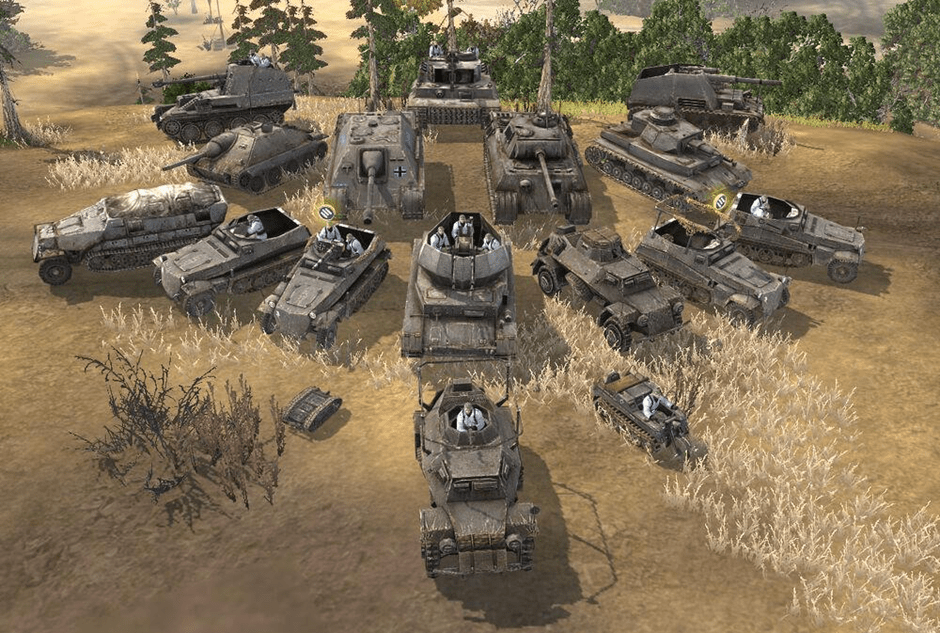
Relic’s dabble with the idea begins in 2009, with the release of Company of Heroes first expansion. Opposing Fronts, introduced two new factions: The emplacement based British Army and the mobile Panzer Elite.
Historically, the Panzer Elite was inspired by the Panzer Lehr Division, a unit made up of veterans and instructors, and one of the few German Panzer divisions in the western front during 1944 to be fully equipped with halftracks. To reflect this, the faction unit roster consisted mostly of light and medium vehicles, and units in close proximity shared experience between them.
The newly introduced ultra light vehicles (the 250 halftrack and 221 scout car variants) solved the problem of balancing the intended vehicle presence with the power regular light vehicles brought to the match. While light vehicles such as the American M8 “Greyhound” or the Wehrmacht “Puma” were mostly impervious to small arms fire, requiring the use of dedicated anti tank weaponry to be taken out, Panzer Elite’s ultra lights arrived earlier and could be brought down with rifles and machine guns. Due to their lack of durability, they mostly relied on outranging their opponents or using hit and run tactics.
The low armor also allowed for counterplay. In Company of Heroes, infantry functions as squads with multiple models. As they lose HP, individual models die and have to be replaced in dedicated points (most of the time, your base) by spending the manpower resource. This means engagements eventually result in resource drain and down times. While vehicles don’t have models to lose and their repairs are free, they usually take some time to complete. The Panzer Elite player may not be losing manpower, but they are losing time by having to use their infantry to repair vehicles.
Panzer Elite’s infantry was as abundant in the field as their vehicles. The bulk of their infantry was made up by Panzergrenadiers, which were a combination of mainline soldiers and engineers and as such they carried the burden of having to fight, repair vehicles and build tech structures. Each tech structure unlocked equipment to specialize them in close quarters combat, long range skirmishing or tank hunter roles and also contained upgrades to increase their model count, repair and capture speed, experience gain and suppression resistance, even a horde bonus.
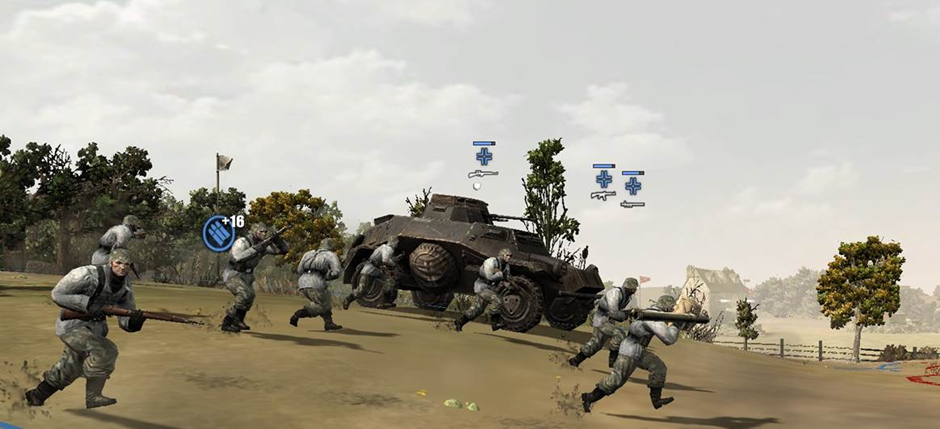
Despite all of this, the integration between the vehicles and infantry elements was limited to infantry being able to repair and mount on their halftracks and having specialized halftracks replacing infantry based support weapons (machine guns to suppress infantry, mortars to dislodge static units and anti-tank guns to hunt other vehicles).
For the most part, infantry and vehicles operated independently from one another. This phrase has some nuance: it not only means the integration was limited, it also carries the implication that vehicles had a more independent role as units than those of other factions, where they mostly complimented their infantry forces. It is quite evident that the Panzer Elite provided the framework for what would become the DAK, but some of that spirit is also carried out by Company of Heroes 3 as a whole.
A few relevant standout units that would go on to enrich the unit pool of the franchise are the Kettenkrad, a tracked bike that zoomed around the map capturing points while the rest of the army fights, the Bergetiger recovery vehicle that could restore vehicle wrecks back to a functional state, and of course the 250 halftrack, which allowed infantry riding in it to fire from inside opening the way for daring maneuvers that went from chasing retreating units or to finishing off vehicles.

OKW: Relic’s undersupplied experiment.
We now move on to the year 2014, when the Company of Heroes 2 Western Front expansion introduced the United State Forces (USF) and Oberkommando West (OKW) factions, both of which were quite experimental with their design and heavily themed after the units that took part in the Battle of the Ardennes.
OKW’s most standout feature was their unique economy. To represent the dire logistical situation of the German units that took part in the Ardennes Offensive, OKW had a built in fuel and ammunition handicap, meaning they got a reduced resource income in all their captured points. They compensate for this by having a greater manpower income, representing the introduction of new conscription laws. On top of that, they could exchange their ammunition income for fuel and vice-versa by using their command trucks and their infantry could salvage support weapons and vehicle wrecks to recover some resources.
Another key component of their characterisation was their use of the Wunderwaffe or Wonder Weapons. We are talking assault rifles with night vision scopes, Infrared searchlights that reveal enemy models in the fog of war and of course, the biggest cats of the German army. Together with their units being able to achieve two extra levels of veterancy than other armies, they shaped OKW game plan towards outlasting their opponents relying on their infantry and light vehicles.
Despite having access to all these tools, their roster suffered from the critical lack of an infantry based machine gun and a medium tank, which were both locked behind doctrines, heavily limiting their choices in the early and mid game.
This original faction design didn’t survive the test of time, and underwent a long process of transformation. In 2016 there was a complete revamp of the faction, ditching the resource handicaps and bringing their resource income back to a normal pace. It came along with an extensive rework of their unit roster and tech structure, moving units around the tech buildings (which also meant the inclusion of the units mentioned above) and the tweaking of certain units in terms of performance and roles. Another key change happened in 2017, when their two extra veterancy bonuses were changed to be passive abilities and bonuses instead of raw stats to reduce the faction’s oppressive performance in the late game.
There were some signs of a struggle between preserving the faction identity and bringing it back in line with the rest of the factions and the evolving meta of the game. For example, infantry still retained the ability to scavenge abandoned support weapons which gave them a unique way to deny enemies of much needed enemy machine guns or anti tank guns, dismantling them after killing their crews. Another example is the raketenwerfer, their unique stealth anti tank gun that could garrison buildings and retreat back to base like infantry. Its unique combination of traits remained problematic because it allowed it to safely move across the map, capturing points undetected, and diving to kill or severely damage enemy vehicles and run back to base avoiding the enemy response. Despite being toned down several times it was eventually rebalanced as a regular AT weapon.
The changes continued up until the summer of 2021, with the latter ones being made by the community balance council, which worked as the proving ground for some of its members who would go on to Relic to work in the sequel. The knowledge gained from the balancing process of Company of Heroes 2 will become instrumental in the development of the third game of the series.
DAK: A new framework for the learned lessons
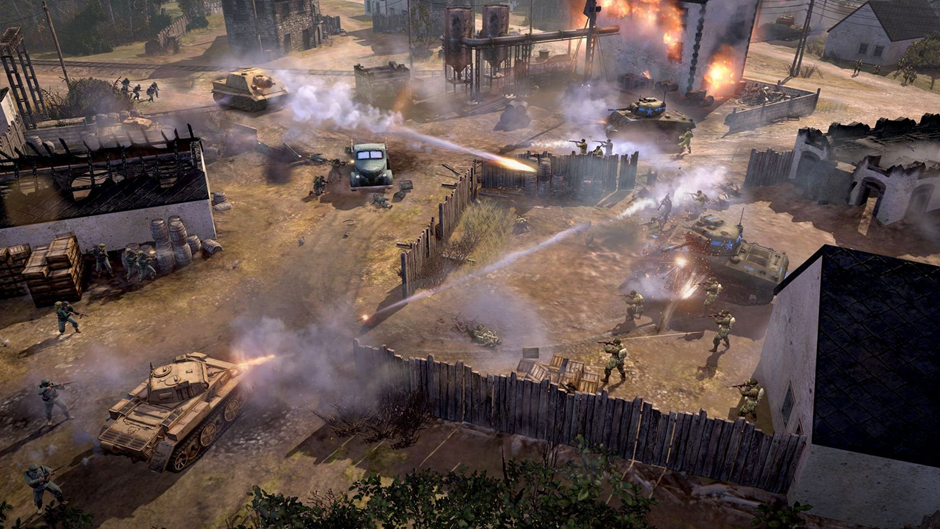
Company of Heroes 3 released in 2023 with an ambitious roster of four factions from the start. These were created with a new dense design philosophy, first tried in Relic’s previous release Age of Empires IV, in which units and maps are very dense with interaction while the game systems are very deep and interlocking, creating a rich multileveled decision making experience.
Evidence of the lessons learned in the previous game is that every faction has readily access to basic defensive tools: engineer units, sandbags, mines and barbed wire, but most notably the access to the triad of support weapons. This provides a solid bedrock on top of which the faction asymmetry is built upon.
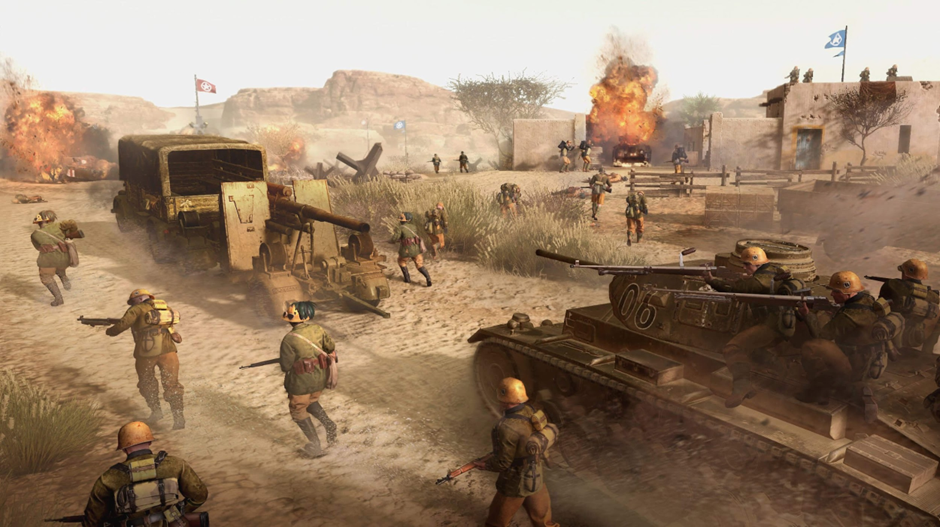
The Deutsches Afrika Korps presents us with a more realized version of Panzer Elite original idea of a mechanized force and manages to convey the OKW idea of a logistically challenged force without resorting to resource handicaps.
The eponymous real life formation provided an ideal backdrop for this faction. Consisting of a mix of German armored and Italian infantry and armored units, it became the source of legends by besting the British army in North Africa through reckless aggression and resourcefulness in the face of dwindling resources due to allied harassment of their sea supply routes and their own logistical issues.
In game, their infantry squads are able to perform rudimentary repairs and are fully integrated with vehicles through a series of adjacency bonuses and passive abilities allowing them to punch above their weight. The synergy is perfectly exemplified with the different possible combinations of infantry and the 250 Halftrack. This unit is the workhorse of DAK’s early and mid game and not only does it provide fire support and means of transportation for the mechanized infantry, it also comes with healing options to keep them in the fight. The 250 also activates the respective bonuses of infantry mounting on it: Panzergrenadiers increase their capture rate and dps and Assault Grenadiers enjoy a free refresh of their grenade abilities that can be used without cost for a few seconds after disembarking.
Even units with only the basic mechanized infantry bonuses can make good use of them. For example, Panzerpioneers with flamethrowers can use the halftrack as a mobile flame projector to dislodge problematic garrisons, and the panzerjager tank hunters can shoot their AT rifles from them. This creates a great avenue of expression for the player.
However, all of this comes at the price of having the most expensive infantry units in the game and hefty reinforcement costs, putting a heavy price on casualties. DAK has to trade steel for blood because their manpower is needed to research their powerful armory upgrades or make use of the Reserve System. The Afrika Korps have a built in Reserve System that works as a sort of a parallel production queue. These are call-in combat groups consisting of a 250 halftrack and either an infantry squad or a towed AT gun or infantry support gun. Every 6 minutes the player can call in one of these combat groups to join the battle. As these unit bundles are cheaper than buying each unit individually the player is presented with the choice of saving its resources for a more efficient purchase later on or spending the resources right away. This mechanic also contributes to keeping the DAK player supplied with vehicles.
Looking at the faction vehicles, most of them are fast, agile and relatively cheap, but also quite fragile. Their weaponry, while functional, becomes outdated rather quickly once their initial time window passes. Even their Panzer III medium tank can’t tackle other medium tanks head on. This favors a hit and run approach, making sure each vehicle is engaging the most profitable targets, securing kills and retreating to avoid sustained combat.
As the match progresses however, veterancy bonuses, upgrades and the appearance of units with higher hitpoints naturally make the prospect of longer engagements unavoidable. This organically drives the player to research the armory upgrades. These include vital upgrades such as giving smoke canisters to vehicles to enhance their survival or tungsten rounds to help them punch through better armored opponents, situational upgrades like bolstering their infantry numbers and increasing the rate at which they gain experience or even late game game changers such as having vehicles repair themselves or enable them to capture territory.
Vehicle upgrades tend to keep their hit and run tactics viable as the match goes on, and some of them also grant vehicles extra hitpoints. All of this makes DAK armored fleets a fearsome foe if left unchecked, so it’s always important to chip away at them and limit their mobility.

Resourcefulness is displayed through their most underhanded tactics. Part of their base roster is the 18-tonne Recovery Half-track which can restore vehicle wrecks (even those from the enemy!) back to a functioning state or scavenge them for manpower and fuel to reinvest them on upgrades or units. Likewise the Reconnaissance Tractor is a more healthy take on OKW Infrared technology. Instead of revealing the exact models of enemy units in the fog of war from the safety of the backlines, the tractor provides DAK players with knowledge of enemy movements and deployments around it through tokens in the fog of war. To add to its role as a force multiplier, it is able to call short mortar and smoke barrages to disrupt enemy deployments, open avenues for attack and make last second saves on your units.
All of this creates an economical identity that still conveys the faction logistical limitations, but does it in a completely opposite way as OKW did before. While OKW starved for resources, DAK hungers for them. Their unit profiles force them to maximize the efficiency of their units, minimize its losses and make use of everything they can to gain an edge over their opponent in the field. Everything they can save, gain or scavenge goes into upgrades that bring them close to unlock their full potential.
Conclusion
Within a new dense design framework, developers were able to use their experience to craft a faction that is both a synthesis and a refinement of previous ideas as well as culmination of the longest and bumpiest roads in the franchise.
Above everything the Afrika Korps is a faction that is both fun to play with and against, thanks to having clear strengths and weaknesses and a solid identity.
With the release of the 2.0 update on the horizon and the arrival of heavy tanks Battlegroups that promise to shake up the meta, I’m curious to see how the faction will adapt to the new challenges.

 Wayward Strategy
Could you provide some further reading to flesh out this comment you made, or talk some more about the “…new dense design philosophy, first tried in Relic’s previous release Age of Empires IV, in which units and maps are very dense with interaction while the game systems are very deep and interlocking, creating a rich multileveled decision making experience.”?
I’m deeply intrigued.
LikeLike
My idea is to flesh out the concept in a future article centered about Age of Empires IV.
You can also check this article I wrote two years ago where I talk about some of the elements that are going to shape my definition of a “dense design”.
https://waywardstrategy.com/2023/06/19/adaptability-putting-the-real-time-in-strategy/
LikeLike