
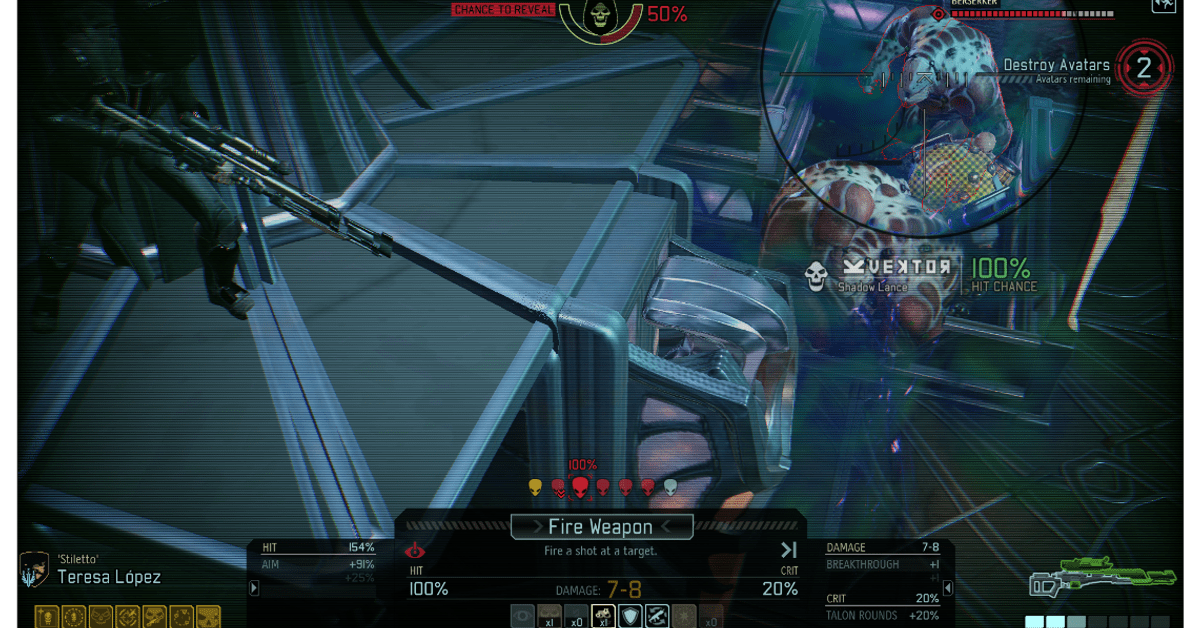

If you’ve spent any amount of time around competitive gamers, you’ve heard people complain about “RNG”, short for Random Number Generation. Maybe you’ve heard “RNG ruins competitive integrity!” “I only lost because of stupid RNG!” “This game is all RNG, there’s no skill.” If you, like me, spend way too much time in these discussions, you might’ve heard people talking about how the more RNG is present in a game, the less skill there is, and how RNG is largely there so that worse players can sometimes win against better players.
These discussions suck. And it’s not because the people involved are arguing in bad faith. It’s because of messy definitions and poor framing. To me, the biggest offender is the following graph, which I’ve seen posted in a bunch of places.
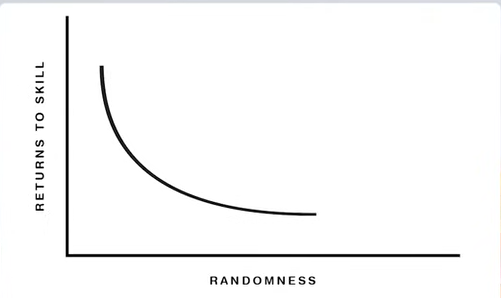
At first, it’s easy to go “well that graph seems right. If a game’s just filled with RNG, there’s no room for skill”. But what games are those? We can say there’s no skill in a game like War or Snakes and Ladders, in which the player doesn’t make a single choice. But once you examine any other kind of game, this falls apart incredibly fast.
Are the top players in games without any RNG “more skilled” than games that have some RNG? What about games that have a lot? Is the best Chess player more skilled than the best Poker player? Is the best Street Fighter player more skilled than the best Magic: The Gathering player?
If your answer is “depends on the skill” or “what do you mean by ‘skilled’?” then you already get where I’m coming from.
What counts as RNG? As Skill?
RNG itself is already a kind of catch-all term. People use it to refer to any kind of randomness in a game. Shuffling a deck, rolling dice, flipping a coin, or any digital version of those are all RNG. Many systems even use those under the hood, such as RPG systems that have a given weapon deal a range of damage (often written as “x-y damage”) per hit might be rolling a die to determine the damage value. If you’ve never heard someone complain about RNG in Dragon Age: Origins, that’s not surprising, but it is using RNG.
RNG can also play a role in setting up an initial game state. In strategy games, having a randomized map to play on is a common practice. Age of Empires uses procedurally generated maps, and a game like XCOM 2 has the player start in one of many possible places for a given map. Games like Hades or The Binding of Isaac randomize the order of rooms you encounter on a given run, and might randomize the types of enemies that appear, but the environments themselves are handcrafted.
This is all to say that RNG is used in myriad ways in games. So what is it about RNG that makes people hate it? In some ways, it depends on what game in particular they’re talking about. But almost always, people cite examples of a game “devaluing skill”. So let’s talk about skill.
When it comes to games, I’ll define ‘skill’ as the ability of the player to overcome challenges presented by the game, through mental and/or physical aptitude. This is a pretty broad definition. Executing combos in fighting games is a skill, deckbuilding in card games is a skill, aiming precisely in a shooter is a skill. And because skills are so varied, players can have all sorts of strengths and weaknesses. When people talk about how “the more skilled player should win”, there’s a combination of all of these types of skill into one mass of “player skill.” The ability to stand a fair shot of defeating difficult opponents usually indicates a high amount of skill, but not really any one skill specifically.
Logically, the players at the top of a ladder system are going to be more skilled than the rest of the players in most games. That game that’s “riddled with RNG?” The top players are still probably putting up consistent results.
Of course, even outside of the top levels of competition, no one wants to feel like the result of their match is arbitrary. But that isn’t a matter of RNG– it’s when players can’t affect the game state. And that’s an issue of player agency.
Player Agency
In Texas Hold ‘Em Poker, players start out knowing only their own hand. They place initial bets based on their hands, and additional bets as more cards are revealed. Imagine a variant where bets can only be placed based on your hand, and no additional bets can be placed later. In theory, the randomness of the game is exactly the same, but players have fewer opportunities to affect the game state. Betting would feel arbitrary, and trying to guess the final board state would be silly.
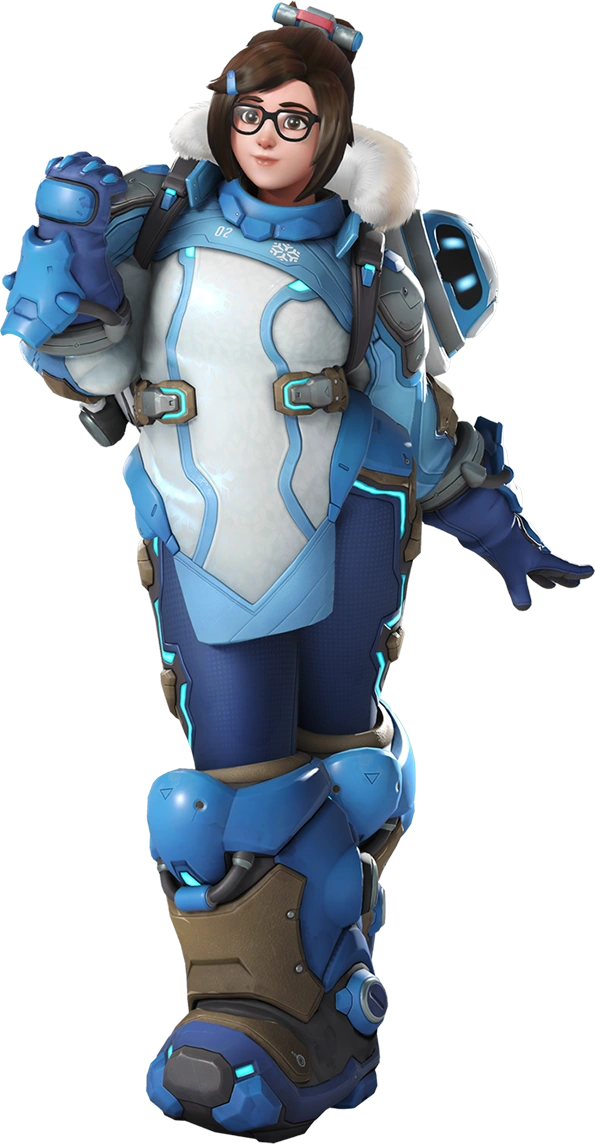
Games are by their nature interactive media. In that way, one of the worst things a game can do is stop you from interacting. A lot of competitive games where a player controls a single character have “stuns”- effects that prevent a player from doing anything for a short time. And always, players complain about them. “Mei’s freeze is so stupid, I’m just not allowed to play the game” is something I’ve heard a lot in Overwatch (1). Or maybe you’re killed so quickly you can’t react. “Rengar just instantly killed me. I couldn’t do anything about it.” Rengar, an oversized cat man in League of Legends, keeps getting reworked, as Riot Games doesn’t want the opponents or the Rengar to feel useless.
Even fighting games tend to have limits on their combo lengths. No one wants to just sit there and watch themselves get beat up. We play games to shockingly, play games.
The examples above have nothing to do with RNG, but people hate them, because players feel like they’re not really allowed to play. While this might have something to do with exhibiting skill, it’s really an issue of feeling like what you do doesn’t matter. And while bad uses of RNG can have this effect, RNG is far from the only thing that can cause it.
Adapting Circumstances
But RNG can actually enhance a player’s agency and find new ways to test them. Skill is about overcoming challenges, and skills like adaptation and improvisation can make for some very fun tests. That moment where you can’t follow the guide anymore, where chaos is introduced, can show us what we’ve learned…and what we can still work on.
Going back to Poker, part of the fun is trying to reassess your hand in light of new cards, as well as reading everyone else, and trying to figure out how the change in game state affected them. RNG makes for unpredictable game states. And if leaderboards are anything to go by, players can very much still affect the outcome.
And this introduces another skill as well: risk assessment. Being able to judge what risks to take is a huge part of many games. In Arkham Horror: The Living Card Game, there’s a deck of Mythos cards that makes bad things happen to the players every round. Do you split up to cover more ground, or stick together in case monsters show up? A horror movie classic, and a fun challenge for players. What if you know there are a bunch of monsters in the mythos deck, but you haven’t drawn any yet? You don’t know precisely when they’ll show up or where, but balancing readiness for adversity with progression through a scenario tests a very interesting set of skills.
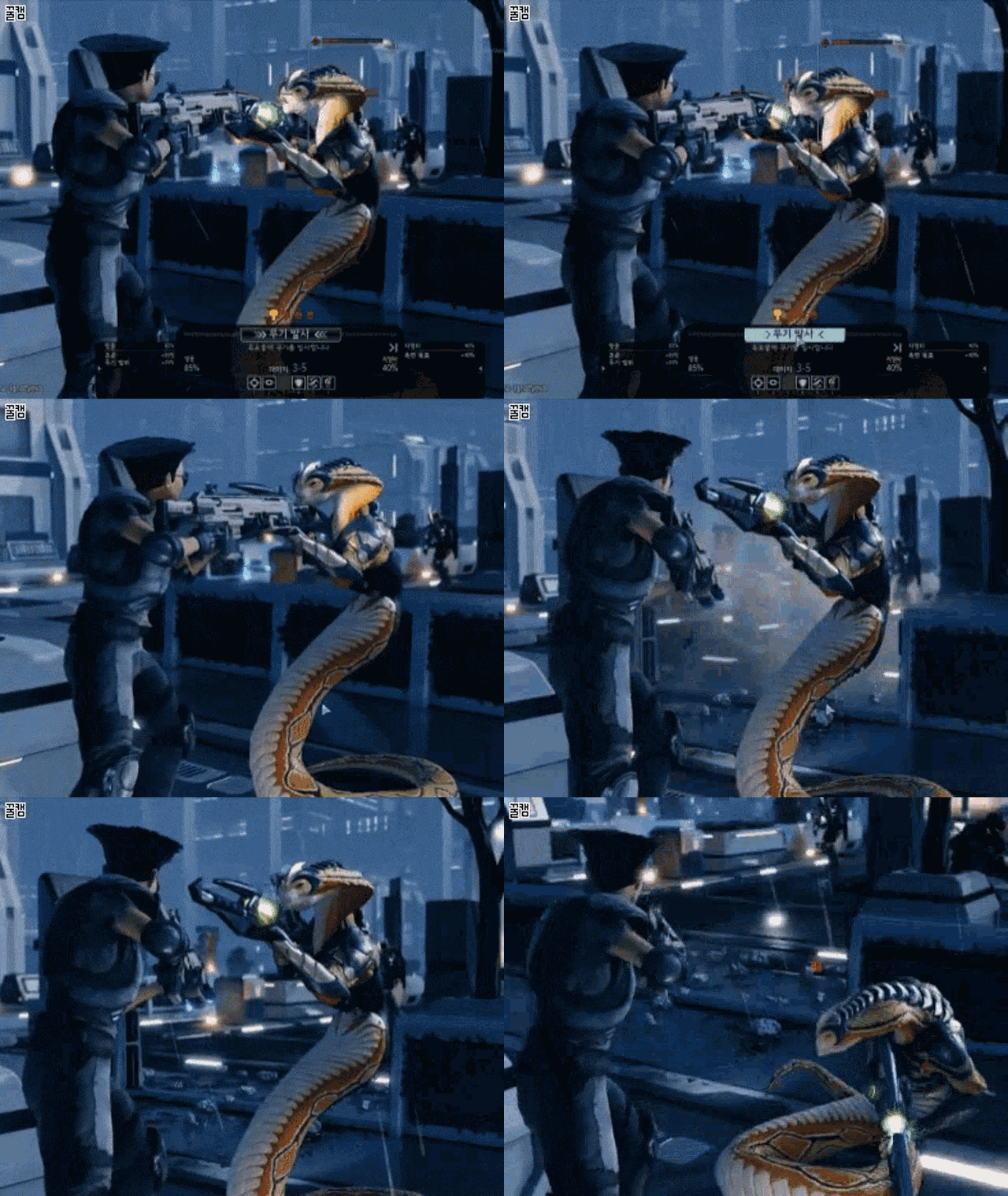
I recently played an XCOM 2 mission where I had a valuable soldier bleeding out, and if the mission lasted one more turn, he would die. I had only one action remaining on one soldier, with one shot to take, and it had a 27% chance to hit. So that made me ask: do I take this shot? If I miss, the last enemy might be about to injure my soldier, and if I hunker down instead, it makes my soldiers hard to hit. But if I don’t take the shot, my incapacitated soldier is dead no matter what. What’s the right call? A huge part of XCOM is asking questions like “do I roll the dice here?” And if you haven’t missed an 80%+ chance to hit attack in XCOM, then this gif should describe the feeling:
Risk assessment and adaptation to circumstances are skills like any other, and are often a fun part of games. The lack of predictability makes for a varied experience, and can often make games tense. They’re not strictly limited to cases of RNG. In Chess, you might make a risky move, hoping your opponent responds to it poorly. Maybe you have to take it, because a cautious game is just a slow loss.
Good RNG, Bad RNG
So if RNG isn’t some monolith, what makes a particular case of RNG good or bad? Obviously this will vary from person to person, and a chess player is going to have different criteria than someone who plays Genshin Impact specifically for the Gacha aspecthb. But there are some common drivers for how we think about RNG.
Let’s start with bad RNG. As I mentioned earlier, taking away the player’s agency is a cardinal sin, and if RNG does that, it’s probably bad RNG. One of my biggest complaints about Magic: The Gathering (MTG) is the wild inconsistency in drawing cards. It can lead to “non-games”, where one player can’t really participate and just loses. One common cause of these non-games is the inconsistency in drawing “land” cards– a type of card that acts as your resource to play other cards. There are plenty of matches where you either draw too few lands, preventing you from playing any cards, or you draw too many, leaving you with no cards on which to spend your resources. MTG is undoubtedly a skillful game, but it’s deeply frustrating how many games feel out of your hands. And Wizards of the Coast is aware of this issue! They’ve been trying different solutions to this for years. They’ve had cards that can be played as either a land or as something else. They’ve experimented with different rules about drawing an opening hand, trying to make the starts of games more consistent. Ultimately, it’s also a game that’s been made for over 30 years, and that limits the scope of what they can do. But it’s telling that most other (especially digital) card games have either different resource systems or no resource system at all.
And players want their decisions to feel like the main drivers of their games. While getting locked out of playing the game is frustrating, it’s equally frustrating to feel like your work and decisions can be undone because you got unlucky. In 1v1 matches of Super Smash Bros, item spawning is almost always turned off. The items themselves can be very swingy, and can create situations where someone wins or loses because the right item spawned in the right place. If you’ve been reading your opponent’s moves and countering them, inflicting a good chunk of damage, and suddenly a heart spawns in front of them and heals them to full health, all those good plays you made are undone. There’s no chance to react, no new dimension to the game opens up.
Good RNG, by contrast, does open new dimensions to the game. By introducing variance, games provide a wide breadth of experiences for players to enjoy. That can test different skills, as we discussed with adaptation and player agency, but it can also just keep games exciting. And we know this partly through the draw of competitive multiplayer games. Part of the reason competitive games can be so fun is the unpredictability of the other players. And in fact, when a metagame grows stale, it’s often because your opponents all tend to play similarly.
In recent years roguelikes, roguelites, and games with elements of those genres have seen a massive surge in popularity. The games never play out exactly the same way, and that’s part of the reason I have around 550 hours between Hades and Hades II. In Hades, not only are the room orders randomized, but the upgrades you get are randomized as well. You won’t get offered a boon from every god, and your abilities change dramatically based on which gods appear. It keeps the game fresh, and means you’re always evaluating a new set of choices.
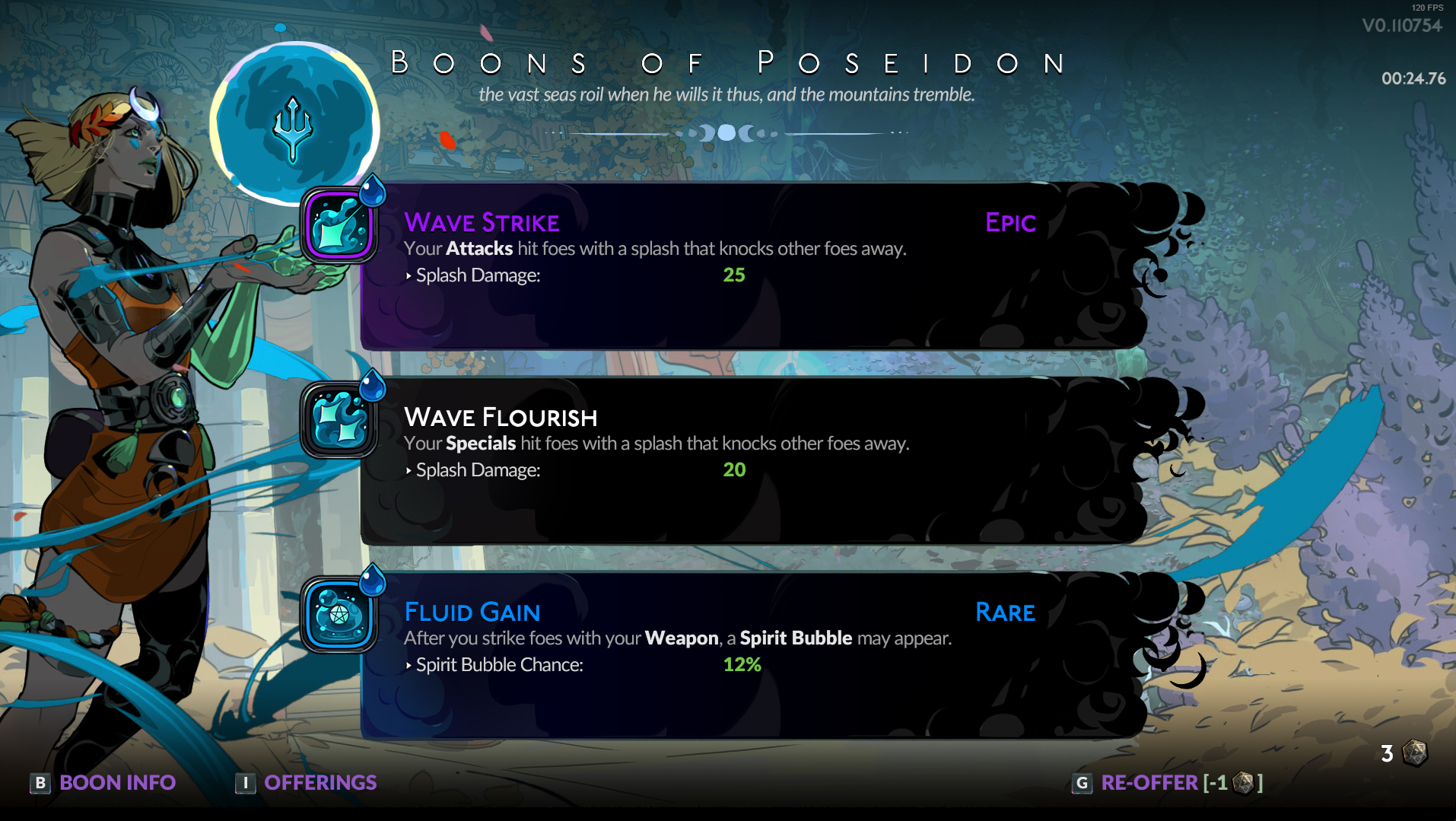
And it’s great for your own personal narratives as well. Those times where you fought your way out of a bad situation or got super lucky and had an incredible run are fun to experience and to talk about. And you’ll have plenty of experiences in between, where you stay ahead because of your intuition or good risk assessment. You get to show off your big ol’ noggin.
Success/Failure vs Better/Worse
The impact of RNG also heavily depends on two factors: how important each roll of the dice is, and how many times the dice are going to be rolled. Having just a few rolls that each matter a lot is gonna create a different dynamic than a large number of individually less important rolls. I’ll refer to these paradigms as Success/Failure or Better/Worse.
Success/Failure is a case where RNG determines whether an action you’re taking works or doesn’t work. In Dungeons and Dragons and XCOM, when a player attacks, they have odds to hit. If the RNG is in their favor, they hit and do damage. If it’s not, they miss and do nothing. This can create incredibly tense moments, where that crucial attack might only have a 50-50 shot of hitting. But it’s also the most prone to players feeling frustrated when their fourth shot in a row misses, even though it had a 50% chance to hit.
Success/Failure can be very dangerous. In Gwent: The Witcher Card Game’s open beta period, there was a patch infamously known as the “Midwinter Patch,” in December 2017. It added a new mechanic, called “Create”, which would show you 3 different cards you could spawn, randomly selected from a pool specified on the card with “create”. Normally, players could only have one copy of “spy” cards, which would provide the unique effect of drawing you a card in a game where that was an enormous advantage. “Creating” a spy was extremely inconsistent, but often game-winning when you succeeded. This made for a large number of games where it felt like it was only fair if both players created a spy, or neither did. Eventually, CD Projekt Red removed the spies from the pool of cards that could be created.
Some Success/Failure dynamics, particularly in single-player games, have “mercy” mechanics to try and mitigate really brutal Success/Failure cases. Baldur’s Gate 3 and XCOM 2 (on Rookie/Veteran difficulty levels) have a mechanic where every time you miss in a sequence, it makes your chance to hit more likely. In a way, this is acknowledging the shortcomings of Success/Failure systems, while attempting to preserve the tension.
Better/Worse is the opposite of Success/Failure, where individual rolls aren’t as important, and have a more diffuse effect on the game. In the digital adaptation of Battletech, the player controls a team of 4 mechs, each of which can have some 8-10 weapons on it. Every attack costs heat, ammo, or a combination of the two, and you get percentages to hit on a per-weapon basis. Some weapons even hit multiple times, like a Long-Range Missile (LRM) launcher that might fire 20 missiles at once. You’re still making a judgment call as to whether you should fire that large laser with a 50% chance to hit, knowing it’ll take a lot of heat to do so. But because you’re also probably attacking with a bunch of other weapons, it’s hard to feel like your turn was wasted if that one laser misses. Mechs also aren’t usually destroyed in a single turn, giving you time to react and adapt to individual attacks. Because there’s so many rolls of the dice, it’s hard to feel like a particular roll was unfair.

Better/Worse, with enough rolls, can often have the effect of making players read the RNG as an average, rather than random. As I mentioned above with the LRMs, you can count on about 80% of them to hit, or 16 missiles per volley. If each deals 4 damage, it makes a lot more sense to think of the attack as usually dealing 64 (16 x 4) damage than to think of it as either dealing 80 (20 x 4) damage or 0. Whereas even in the same example, we don’t think of the single laser attack quite in the same way. With enough rolls, or low-enough impact on individual rolls, RNG ceases to feel like a gamble.
But Better/Worse does come at a cost: it loses some of the moment-to-moment excitement that can come with the craziness of Success/Failure. As frustrating as a bad roll can be at XCOM, when your ambush wipes out an entire enemy squad, you feel like Sun Tzu. And in part, you feel that way because you know how the game can make you look like Zapp Brannigan when you fail.

If we think of these paradigms as a spectrum, where on one side you have drama, and on the other, we have predictability, we can see that this is another dimension to RNG. There are both great games made using every part of this spectrum, and terrible games that either make you question why they have RNG at all, or feel like you’re always at the mercy of the dice. A game like Gwent, as mentioned above, stresses consistency, and because of that, the create mechanic has always worked better the less splashy it is. But in XCOM, the better you get at the game, the more you understand that the RNG is both fair, and something you can often plan for.
Where does this leave us?
Hopefully this discussion has given you some new ways to talk about RNG. It’s a huge part of so many games, and a small part of so many more. There’s so many good and terrible things it can do for games, and it’s worth examining what makes it work. Why do I prefer attack rolls in Dark Heresy over D&D? Why do people like Mario Rabbids’ attack rolls more than XCOM’s? Why does Magic: The Gathering rely on inconsistency, whereas Gwent tries to be more chess-like?
There’s a lot to unpack here. Ways that randomness can make for great games are always being explored. And, of course, sometimes games will get it wrong. But the mere existence of RNG doesn’t make a game into Snakes and Ladders. Your favorite game probably has RNG somewhere.
Let’s move away from “RNG ruined this game”, to “this mechanic ruined this game.” Randomness isn’t some boogie man hunting skillful games to wipe out the fun. It’s a tool.


“Risk assessment and adaptation to circumstances are skills like any other, and are often a fun part of games.” is honestly the most productive angle to tackle the RNG discussion. How does RNG allows for a rich decision-making enviroment?
LikeLike