

Greetings commanders, I hope 2026 finds you well!
Between the scorching heat of the summer of the southern hemisphere and sudden deluges in my hometown, I’m making the most of my holidays playing ranked matches in Company of Heroes 3.
Last year I talked about how the design of the Company of Heroes 3 Deutsches Afrika Korps (DAK for short) faction was the result of lessons learned from previous games and the polishing and coalescence of tried and tested ideas.
I was itching to write about the game again, and now that I have a greater understanding of the game I wanted to talk about faction design in more general terms, focusing on the design choices that make each faction have such a solid identity while also retaining a huge shared component between them.
Precedents
I’ll start by offering a brief summary of the franchise record regarding their factions in order to set the stage.
Over the years the Company of Heroes franchise has had a power and design creep issue with the factions introduced after the original release of the game. “Opposing Fronts” (2007) and “The Western Front Armies” (2014) introduced new armies in pairs, probably influenced by their stand alone nature. These shared themes, mechanics and unit archetypes, distancing themselves from the vanilla factions. A player could start playing the game with one of these stand alone expansions and have a cohesive experience and one faction for each side.
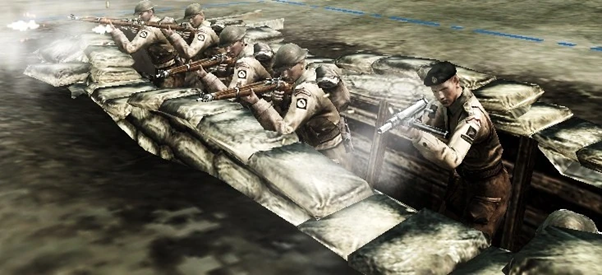
However, having factions that seemed to be designed to fight each other resulted in messier interactions with the original ones. Company of Heroes 1 British forces dominated the Wehrmacht with their slit trenches and the US had issues dealing with the Panzer Elite abundance of early vehicles. In Company of Heroes 2, the delayed timing of the Ostheer MG42 left their infantry at the mercy of the US riflemen, while Oberkomando West Kubelwagen (which had suppression on release) and strumpioneer combo stomped the Soviets. What made sense in a match up didn’t in the other.
On top of this, some asymmetry choices created critical gaps in the factions rosters. Having access to the King Tiger heavy tank meant OKW didn’t have a medium tank. The USF riflemen strength was supposed to cover up for the lack of proper mines and the variety of UKF anti tank options justified not having access to AT grenades to deter light vehicles dives. We might add to the equation that Company of Heroes 2 original factions had to retreat their engineer units back to base to build their production structures while western front armies could do it automatically or had to upgrade vehicles to tech up.
Eventually, the devs came around fixing or mitigating the disparities by adding abilities, effects, units or even completely reworking factions. In the process however, players piled up frustrations, bitterness and a sense of unfairness that probably shaped the franchise online discourse towards a “us vs them” mentality.
The latest entry, Company of Heroes 3, tackled the challenge of releasing with 4 factions right from the start. This provided the opportunity for a more cohesive design that was more mindful of the possible interactions between them. At the same time, there was a departure from the more wild and experimental approach to asymmetry and some of their older design tropes, namely, factions that had strong early/late game, which turned matches into battles of endurance.
This gave way to a much more measured approach to asymmetry that in my opinion succeeded in finding a balance between the faction’s uniqueness and consistency while creating healthier game dynamics. Its robust counter system and the homogenized distribution of defensive tools can attest to that.
The importance of the latter cannot be understated. A solid foundation of universal defensive mechanics is necessary to diversify the possible offensive approaches of each faction. Fighting games understood this principle ten years ago, and it’s a great note to borrow from them.
Now that we have taken a quick look at the fundamental principles and objectives of the Company of Heroes 3 design choices, we can finally dive into the faction design proper.
To analyze this approach to faction design I’ve used my own experience and developer diaries to systematize it as best as I could.
From my perspective, each faction appears to be composed of different layers of mechanics, abilities and unit archetypes that pile one on top of the other: first are their theater and playstyle layers, which together compose a shared toolbox that allows us to draw points of comparison between them; next is their theming, providing the more unique and distinctive elements; and finally the Battlegroups that customize the experience.
I’ll start describing and analyzing each of these layers and how they interact with each other.
Theaters and the tools to wage war
Company of Heroes 3 is set in the Mediterranean Front, encompassing the North African and Italian theaters. It could be deduced from developer diaries that each theater is intended to shape the way armies fight. While this could be interpreted as merely talking about how the maps shape the way the players develop their strategies, I firmly believe this also goes to the way armies from each respective theater wage war.
Each theater has its own roster of units and structure archetypes that are common to their respective factions and differentiates them from those in other theaters. This is the first of our layers.
The British and the Afrika Korps will be our North African factions, while the US forces and the Wehrmacht represent the Italian theater.
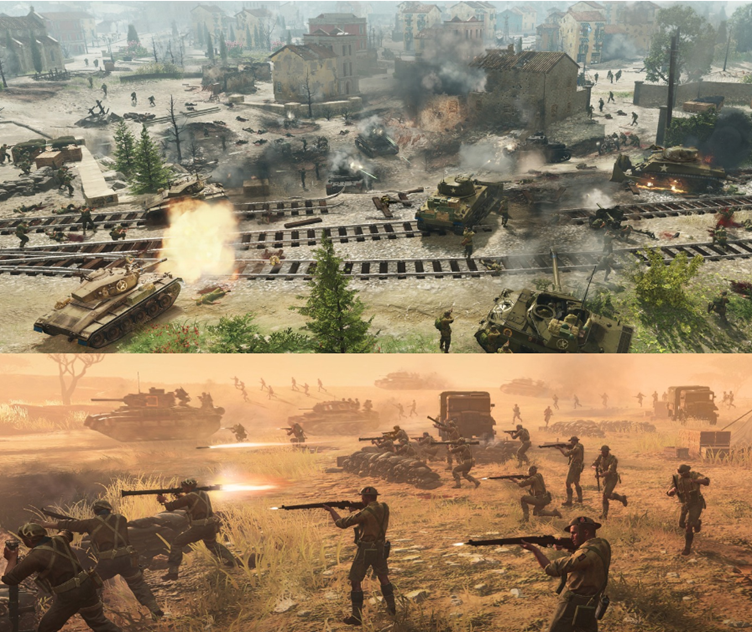
The North African factions start with a tech structure added to their HQ where they can research their respective upgrades. Light vehicles play a huge role in the roster of the two desert factions, a sign of this integration is that both armies have an excellent utility vehicle in their respective opening stages. Their vehicles are mostly geared towards mobility and firepower rather than durability, making them quite adept at aggressive maneuvers as much as they are blowing up in flames. Even their medium tanks, the British Crusader and the Afrika Korps Panzer III are cheaper and lighter than their mainland counterparts, but can roam the battlefield in deadly packs. Last but not least, their final tech structure houses a deadly long range AT weapons in the form of the 17 Pounders and the Flak 88mm, which are needed to zone out the heavier tanks the rest of their arsenal can’t deal with effectively.
In the Italian mainland, the early armies of the US forces and the Wehrmacht rely heavily on their mainline infantry and have a weapon team that puts the ribbon on their early game composition: The Wehrmacht’s Mg42 machinegun will shred allied troops that try to overwhelm the slower firing grenadiers, while the American M1 mortar team will force the axis troops to stay on the move much to the advantage of their riflemen. In a broad sense, you could say vehicles play a more supportive role in the midgame as the bulk of the fight will be carried by the axis elite infantry (Panzergrenadiers or Jaegers) and the formidable power of the basic US riflemen as upgrades and veterancy start to pile up. The more robust arsenal of medium armor can dominate the combat at the later stages of the match. These factions can place medical structures that recover casualties for better manpower efficiency. Other similarities are the presence of dedicated sniper units, upgradable halftracks and modular field fortifications.
These two different toolboxes make the most of the setting capturing the dashing open ground engagements of the north African desert and the grinding land battles of the Italian campaign. These also work as a basis to which the subsequent layers will build upon.
A spectrum of playstyles
Early in development, developer interviews described their factions in a spectrum between mobile with cumulative power and static with raw power. These playstyles are our second layer. We can find armies in both Africa and Italy that adhere to them through another set of attributes, unit roles and mechanics.
As the name suggests, mobile factions are adept at fighting on the move, looking to disorganize the enemy and minimize its effectiveness. They have ample tools to overcome the obstacles their opponent may place in their way and their units stay relevant throughout the match thanks to the cumulative power granted by upgrades. We are talking about the US forces and the DAK, whose mainline infantry units only suffer from a 25% penalty when firing on the move compared to the other factions 50%, and even share a similar dps curve that incentivizes avoiding sustained long range combat in favor of maneuvers that allow them to close the gap as fast as possible and running down retreating infantry. Looking at their tech structure, you can notice that their second tier is geared towards supporting their mainline units, unlocking machineguns as a countermeasure for massed infantry, an infantry based AT unit to counter vehicles with better mobility at the expense of the safety of range, and a specialist unit that excels at ranges
On the other side of the spectrum, we have the static factions, which prefer to keep the enemy at range through smart positioning, even on the attack. Their tools aim to repel, disrupt or zone out the enemy until they can mount their own attacks through the raw power of their units. These are the UK and the Wehrmacht which feature the best support weapons in the game and a withdrawal mechanic that solves the issues that may stem from units that outlive their combat potential.
Keep in mind the playstyles are described in terms of a spectrum. All factions have mobile and static units, as well as upgrades and units that are strong out of the gate. It’s the role each one of them play in their compositions that determines this characterization.
The similar playstyles and theater toolboxes create a common gameplay experience between factions, which can help players grasp the intended way to play each faction and also how to counter them. This dual layer also provides enough differences between factions with similar playstyles to make the dynamics of their matches interesting.
To put all of this in perspective, you can attack with Rifle Sections and Grenadiers (both units which miss half the shots they fire on the move), but you will do so by issuing attack move orders, so that they engage at maximum range and then you micro them to cover to progressively outflank their opponents. When these two clash however, the excellent accuracy but slow rate of fire of the Rifle Sections forces them into a defensive stance whereas the grenadier will be pushed into an aggressive role, using their higher model count and faster rate of fire at close range to grab the British by their belts.
This is what makes the developers avoidance of the words aggressive or defensive shows its validity.
Theming and Authenticity
Once we combine the theater and playstyle layers we can start drawing conclusions about how each army will play out. The DAK manoeuvres with vehicles while the US will do so with infantry. Meanwhile the British will hold the line until they can counterattack with light vehicles whereas the Wehrmacht will do so with elite infantry until their medium armor can finish the job.
This functional characterization, while correct in a broad sense, still can’t completely describe the factions. Paraphrasing the fighting game community reactions to Capcom producer statements “Factions are not a sum of functions”. You have to take into account the more unique elements that grants every faction their own distinct identity. Theming plays a fundamental role.
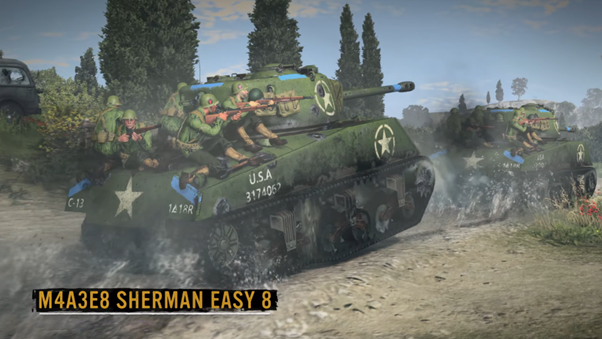
The US forces are all about the individual firepower and aggressive manoeuvrability of key units (Riflemen, the Greyhound and the Sherman) using recon, smoke and air power to locate and overwhelm the enemy while the Afrika Korps prefer the synergies between their mechanized infantry and vehicles, emphasizing the riding mechanic to deal critical blows with speed and surprise, minimizing their casualties and using their reserves to keep the match rolling. The more specialized British will seek to create killzones, denying cover and blocking approaches to maximize their bonus for fighting against exposed units, mauling the enemy with copious amounts of artillery before their vehicles can deal the knockout blow. The Wehrmacht focuses on endurance, delaying and containing the enemy until better units can enter the battle. The grenadier healing and merging with other units translate into a tenacious defense at first and an unrelenting attack later.
There are also unique twists on common mechanics, which can go a long way to help differentiate them. Wehrmacht Transfer Orders allows them to trade grenadiers for elite units for a midgame power spike, whereas the British Withdrawal and Refit refunds their surviving light vehicles for a late game power spike. The US forces don’t start with an upgrade building, but can choose between three different ones to focus on improving their infantry, vehicles or air power.
A great effort was put into translating the combat doctrines of each army into gameplay, even fixing some design mistakes from past iterations along the way. For example, the US forces had a persistent issue of running into machineguns or AT guns in previous games, as their recon units came in later stages of the match or were vehicles. Their new starting unit, the Scout squad, seems like it was taken from the pages of the soldier’s handbook. These small riflemen teams are fundamental to locate and smoke enemy units and are even capable of using stealth to keep tabs on them.
All of this is built like the cherry on top of the previous layers, creating a continuous and cohesive experience for each faction. Players will then gravitate to the ones that suit them better either by preferred gameplay, theming or being proficient at the central skills each one of them demands.
This last component also has the added benefit of turning every army into the training ground of the core skills that govern Company of Heroes 3. You should aim to discombobulate the enemy like an American, create kill zones like a British, direct support weapons like the Wehrmacht and manage vehicle fleets like the Afrika Korps with whatever faction you play.
Battlegroups and customization
Battlegroups are this game take on the doctrine system. These are groups of abilities, tactics and units divided in two branches that the player can unlock with command points that are obtained as it fights and techs up. It gives the player three different kinds of choices: Which battlegroups am I bringing to the match? Which one should I choose in this situation? In which order should I unlock both branches?
Battlegroups have a dramatic effect on each faction playstile, either doubling down on their core playstyle or deviating from it. They constitute the final layer of the game’s faction design, adding customization and helping to shake up some stiffness out of the established design.
The greatest example of this might be how 3 out of the 6 released battlegroups for US twists its core gameplay upside down, forgoing riflemen to stall with machineguns and support units until elite infantry (Paratroopers or SSF Commandos) or halftracks (Heavy weapons) can carry the fight until tanks roll out.
Choices within the same battlegroup can lead to a wide variety of approaches: With the Italian Combined arms battlegroup a DAK player can ditch its mechanized gameplay in favor of more conventional infantry, or outright ignore those and add new bonuses to their mechanized infantry. Maybe only use the Italian vehicles for shock or prefer the utility of its offmap abilities.
A Battlegroup might achieve this level of customization by borrowing elements that are typical from other theaters, playstyles or that belong to other factions. That’s how we end up with the Americans fielding towed AT guns or some of the Afrika Korps vehicles in the hands of a Wehrmacht player.
Conclusion
We’ve been able to explain the game’s faction design through a series of layers of mechanics, attributes, abilities and unit archetypes that provide a common gameplay experience that’s enhanced by unique elements that grant each faction its own identity, with a final layer that embodies player expression. We have also explained why certain of these approaches to faction design are more effective at creating an asymmetric gameplay with healthier dynamics.
Rest assured this is not the first time we are seeing this particular implementation. One iconic example of this method of faction building is Warcraft III, a game which also made the jump from two to four factions, but we could also name Battle for Middle Earth.
Amongst these, Company of Heroes 3 is the latest implementation and one that we can continue to watch evolving.
 Wayward Strategy